Treasury COINS Act Rule Would Ban US Investment in Chinese and Russian Superintelligence, Supercomputing and Hypersonics
The Treasury Department on 22 October proposed a rule that would stop Americans putting money into companies in China, Russia, Iran, North Korea and Cuba that build superintelligence systems, supercomputers, quantum machines, hypersonic weapons or certain biotechnology. It is the first rule written under the Comprehensive Outbound Investment National Security Act, the COINS Act, which Congress folded into the FY2026 defence bill last December. Comments close on 7 December.
The proposal turns a programme that started as a 2023 executive order aimed at China alone into a statute-backed regime covering five countries and six technology families. It also hardens the AI piece. Under the current rules, a US investor backing a Chinese AI developer often only had to tell Treasury about the deal. Under the new text, investing in any entity developing a “super intelligence system” is simply banned. That’s Treasury following the administration’s September decision to rename artificial intelligence, the subject of an earlier CrossGov.com column.
The notification category for AI disappears. Prohibited is the only box left.
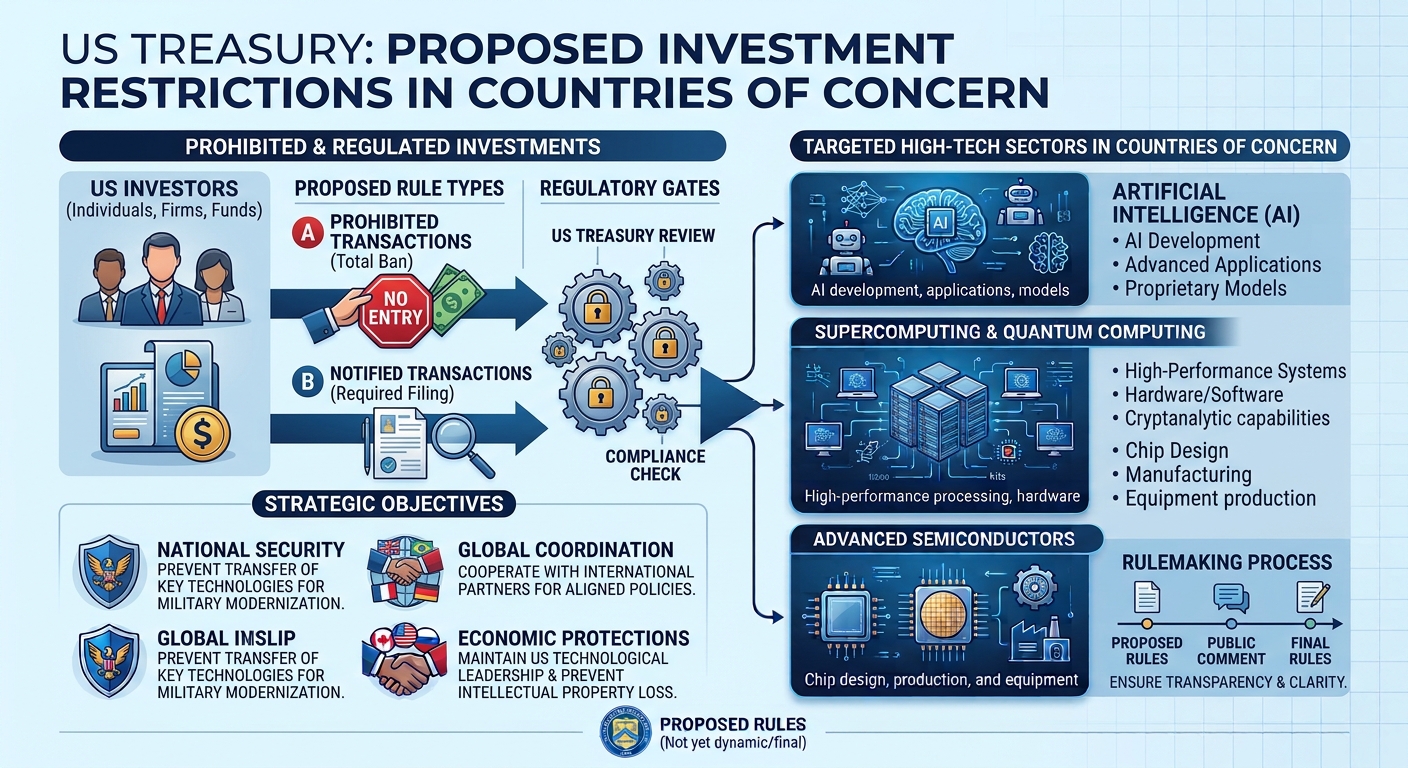
Illustration: CrossGov.com
Six technology families, two lists
Semiconductors stay in, with a wider net. The ban now reaches radiation-hardened chips, photonic integrated circuits and high-bandwidth memory, the stacked DRAM that sits next to every AI accelerator. Chip work that isn’t prohibited still has to be reported. Quantum computing, sensing and networking stay banned, and the rule adds quantum algorithms and applications. Supercomputers are prohibited outright, while high-bandwidth, low-latency interconnects go on the notify list.
Two families are new. Hypersonics covers the vehicles themselves, their propulsion, certain materials and test facilities, with sensors, control gear and software on the notify list. Biotechnology covers bio-derived compounds, brain-computer interfaces, biomanufacturing equipment, biological design and sequencing tools, and bioinformatics.
Who counts as a covered foreign person is drawn wide. Citizens and permanent residents of the five countries, companies incorporated or headquartered there, their governments, members of the Chinese Communist Party Central Committee, firms they control, and firms elsewhere that earn more than half of a key financial metric from covered persons.
Venezuela was on the list Congress wrote. It’s off the proposed one. Treasury says the Maduro government no longer exists after US forces captured him in January, and the administration recognised Delcy Rodríguez as head of state on 5 March, so the country no longer meets the definition. Treasury added that some Venezuelan deals could still be caught, without saying which.
Index funds stay out, venture money doesn’t
The rule is aimed at the deals that carry know-how with the cash: venture rounds, private equity, joint ventures, new plants and acquisitions. It leaves the ordinary investor alone. Publicly traded shares, mutual funds, index funds and ETFs are excepted, as are limited partner stakes of $2 million or less, employee stock awards, binding capital commitments made before the final rule and buyouts of a covered owner’s stake in a company outside the five countries.
A $50,000 threshold, counted over the previous 12 months, exempts small deals from notification. It doesn’t exempt anything from a ban. Notices are due within 30 days of closing.
There will be no Treasury screening of deals and no public list of covered companies. The investor carries the burden of a “reasonable and diligent inquiry”. Penalties run up to the civil maximum under the International Emergency Economic Powers Act, and Treasury can order a prohibited stake sold. A US person can ask for a national-interest exemption, and anyone can send Treasury evidence that a foreign company should or shouldn’t be covered.
Enforcement under the old rules has already begun. In July Treasury fined a US company $200,000 for failing to report a $92,500 investment by a subsidiary in a Chinese AI and robotics firm. Small numbers. The signal was the point.
Russia on the list, China in the crosshairs
Russia’s place in the proposal lands days after the President eased sanctions on Moscow as part of the diesel arrangement with Vladimir Putin, a move senators of both parties say cuts against what Congress wrote into law. In money terms Russia matters little here. US venture capital left years ago and sanctions already block most deals.
China is where the capital went, and where it still wants to go. The rule closes the funding side of the gap that chip export controls left open: Washington has spent three years deciding which Nvidia parts can ship to China, while a US fund could still back the Chinese start-up that designs around them.
The timing sits awkwardly with the US-China trade truce, now extended to 10 January 2027. The proposal doesn’t touch tariffs or export licences, but Beijing has treated every past round of outbound limits as a trade measure, and the comment period ends five weeks before the truce does. The COINS Act gives Treasury about 450 days from enactment to finish its rules, which points to a final version around March 2027.
Comments go in through regulations.gov until 7 December. Then the lawyers rewrite their fund documents.