Congress Needs a Verifiable Account of What the Iran Strikes Achieved
A military campaign can produce extensive destruction without producing a settled answer about what an adversary can still do. That distinction matters whenever an administration asks Congress and the public to accept a declaration of success. Targets struck, facilities damaged, weapons remaining and production capacity restored are different measurements. Treating them as interchangeable makes oversight weaker precisely when the consequences are greatest.
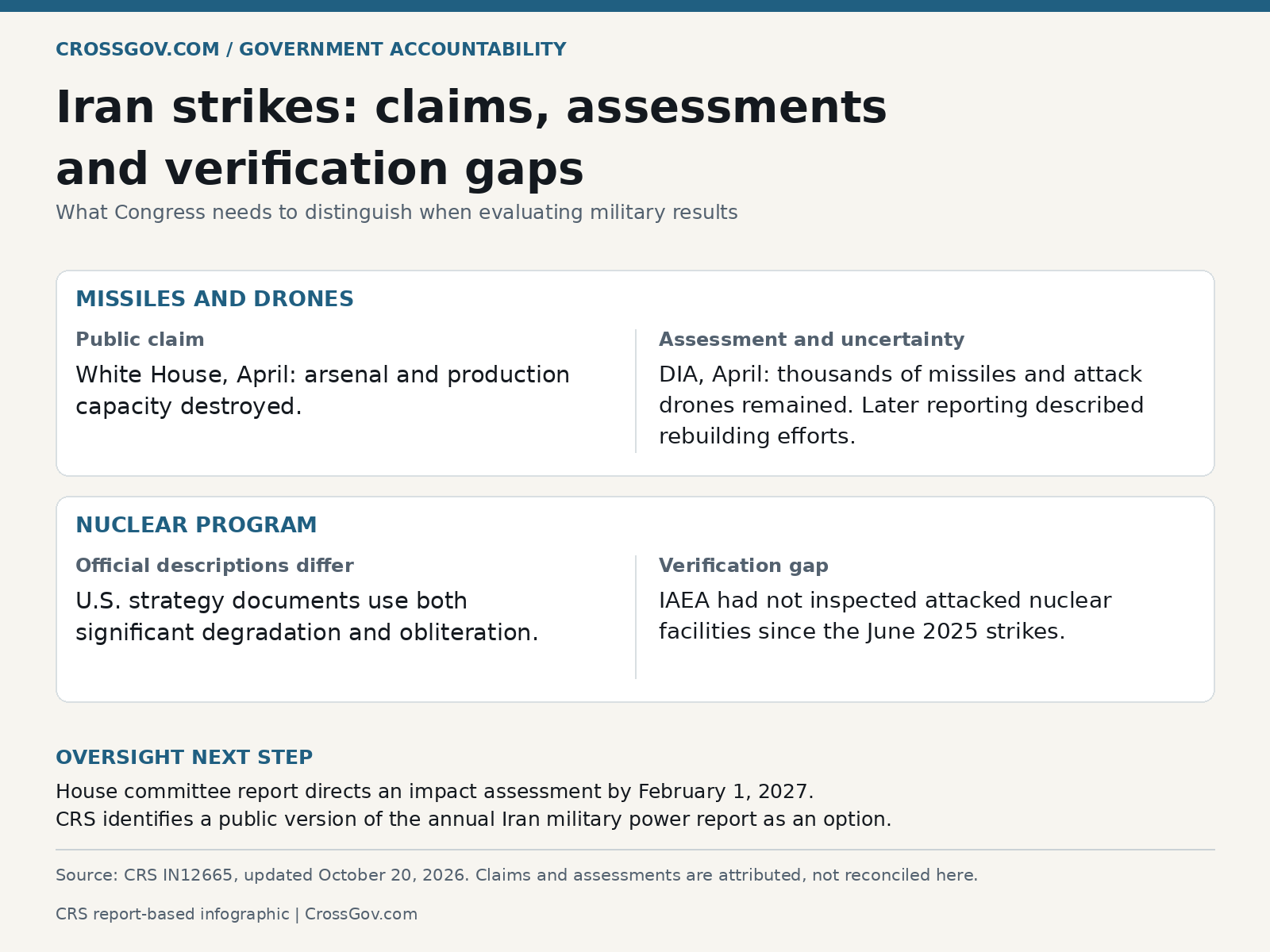
Photo credit: PXEF.com.
The Congressional Research Service’s October 20 update on U.S. military operations against Iran’s missile and nuclear programs illustrates the problem. It places the White House’s April assertion that Iran’s ballistic missile arsenal and production capacity had been destroyed alongside an April Defense Intelligence Agency assessment that Iran retained thousands of missiles and attack drones. The report also discusses subsequent reporting about reconstruction, while acknowledging damage and obstacles to rebuilding. These assessments do not establish that the campaign achieved nothing. They do establish the need to distinguish substantial degradation from elimination.
Congress should require that distinction in every serious assessment of the operation. What capabilities were removed? Which remain usable? How long would reconstruction take under different assumptions about outside assistance and access to components? A success claim becomes more meaningful when officials explain its limits. Otherwise, a statement that sounds definitive today can become the justification for another round of strikes tomorrow, with little explanation of what changed.
The nuclear picture carries its own verification problem. CRS states that the International Atomic Energy Agency has been unable to inspect the attacked nuclear facilities since the June 2025 strikes. It also identifies different descriptions in U.S. strategy documents: the National Security Strategy described significant degradation, while the National Defense Strategy described obliteration. The House Armed Services Committee’s report accompanying its version of the FY2027 defense authorization bill directs an assessment of the operations’ effects by February 1, 2027. CRS also identifies a public version of the existing annual Iran military power report as an option for Congress.
That is a useful oversight route, provided reporting becomes more than a deadline satisfied by a classified document. Lawmakers need access to sensitive evidence, and the public needs an intelligible account of the conclusions that can be disclosed. An assessment should identify confidence levels, unresolved questions and the evidence required to resolve them. Uncertainty belongs in the explanation; hiding it does not make the underlying judgment stronger.
Congress does not need to choose between reflexively endorsing military claims and reflexively dismissing them. Its responsibility is to test them. The central question is whether the campaign produced a durable reduction in the threats used to justify it, and what obligations remain if it did not. That answer requires evidence capable of surviving scrutiny after the announcement has faded.