Congressional Commission Says PLA Seeks Nvidia Chips for AI Weapons Despite US Curbs
A US congressional commission has warned that China’s People’s Liberation Army is seeking advanced Nvidia processors for AI-enabled weapons even as Washington restricts exports of the technology. The finding, published November 18 in the U.S.-China Economic and Security Review Commission’s 2026 annual report, places the Pentagon’s technological competition with Beijing squarely inside a Commerce Department enforcement problem.
The commission draws on research published in April by Georgetown University’s Center for Security and Emerging Technology, which examined PLA procurement documents from earlier years. Those records show military interest in obtaining advanced American computing hardware. They do not, by themselves, establish that the requested chips were delivered, reached particular weapons programs or were acquired through an unlawful transaction. That distinction matters when Congress considers how much evidence is needed to change export rules.
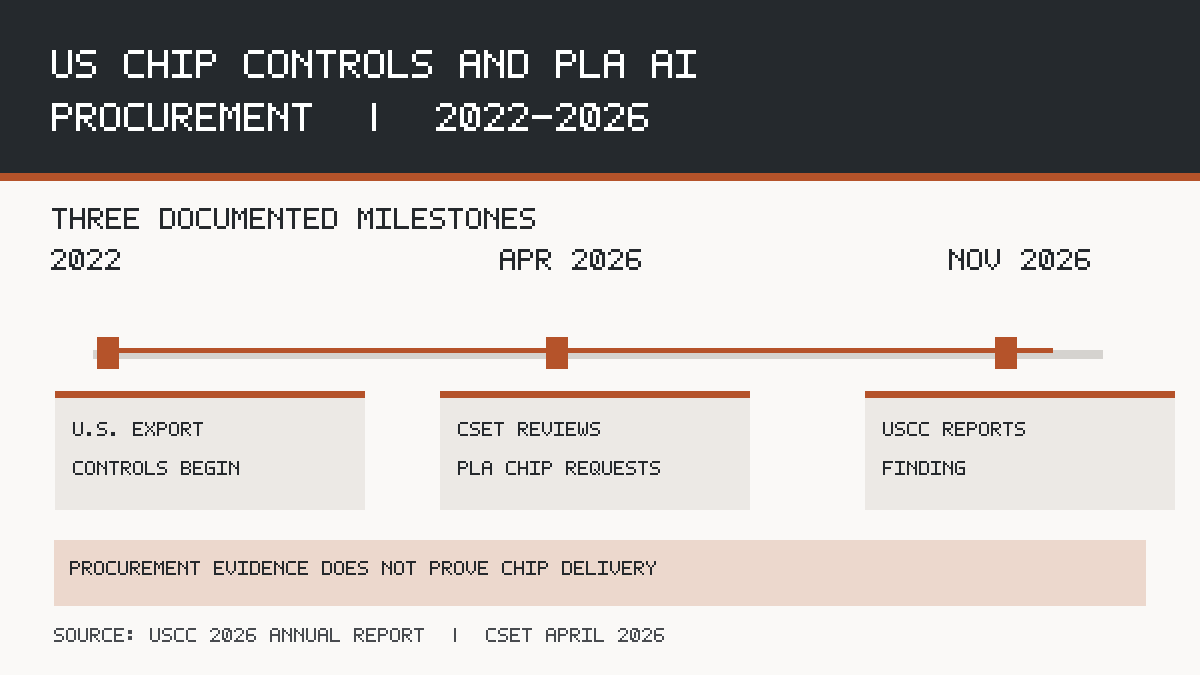
Chart: CrossGov.com from the USCC 2026 annual report and April 2026 CSET research, hosted at Pxef.com.
The military demand behind the chip question
China’s armed forces describe their effort to bring AI into military operations as intelligentized warfare. The commission identifies applications including autonomous drones, target recognition, command decision support, the allocation of firepower and logistics. These are systems in which computing capacity may affect the speed of training and the complexity of models that military developers can test and deploy.
The report says PLA exercises have already included crewed and uncrewed teams, automated recognition of targets and AI-assisted command functions. That is a description of military activity, separate from the question of whether a particular Nvidia product was used to build any one of those systems. Procurement records are an early warning signal. They are not a complete inventory of hardware inside the PLA.
The commission also identifies a domestic technology gap. Chinese processors, including Huawei’s Ascend family and Cambricon’s Siyuan series, still trail advanced Nvidia and AMD offerings, according to the report. That gap helps explain the demand for US-designed processors even as Beijing encourages Chinese customers to buy domestic hardware. A policy designed to reduce dependence on foreign chips does not immediately erase the engineering advantages of the suppliers it seeks to replace.
Washington faces an enforcement test
US export controls on advanced AI chips began in 2022 and have been revised repeatedly. Their aim is to limit the computing power available for specified military and other sensitive uses in China. Actual enforcement has to follow hardware across distributors, data-center operators and possible intermediaries, often after the original sale. A rule that bars shipment to a military end user accomplishes little if the same end user can get the chips through an unverified chain of buyers.
CrossGov.com has previously covered the licensed Nvidia H200 export arrangement, in which permission for selected commercial sales raised difficult questions about diversion and monitoring. The commission’s latest finding adds a military procurement dimension to that debate. A Chinese commercial buyer and a PLA purchasing office cannot be treated as equivalent simply because both want high-performance accelerators.
There is also an evidentiary limit. The commission’s description of attempts to evade export controls does not establish the scope of successful evasion. Washington needs information on specific shipments, ultimate users and the movement of computing resources to determine which controls are working and where gaps remain.
What the commission wants Congress to do
The 2026 report recommends closer oversight of the Commerce Department’s Bureau of Industry and Security. Among its proposals are tracking technology for controlled chips, a stronger intelligence function inside BIS and a cloud-access approach under which certain sensitive computing capacity could be rented under monitored conditions rather than sold as hardware.
Another recommendation would amend the Export Control Reform Act of 2018 to require exporters to certify that sales of advanced AI chips to China do not divert capacity needed by US buyers. The commission wants that accounting to extend beyond finished processors to advanced wafer fabrication, high-bandwidth memory and packaging capacity. It also calls for auditable records, annual BIS reporting to Congress and a review process for exceptions.
These are recommendations from a congressional advisory commission, not enacted law. Congress would have to decide which proposals to legislate, how to fund enforcement and what evidence would justify a new restriction. Exporters would still need workable procedures for identifying the ultimate customer and proving that hardware or computing access is used as licensed.
The decision is about capability and verification
China’s effort to modernize its military with AI is larger than any one chip order. American semiconductor design remains a strategic advantage, but it creates a continuing policy dilemma for Washington: commercial exports generate revenue and sustain an American technology ecosystem, while uncontrolled access can also strengthen a military competitor.
The useful question for Congress is narrower and more measurable than whether China wants Nvidia chips. The commission says the PLA does. The issue now is whether US agencies can detect restricted procurement, verify end users and enforce license conditions without confusing a documented request with a documented delivery. A procurement document can justify scrutiny. A proven diversion requires a stronger record.