The Army Gives Soldiers Free Gigabit Wi-Fi in Every Permanent Barracks at Fort Riley and Fort Wainwright Through a University Partnership
The Army is expanding free high-speed Wi-Fi to all permanent party barracks at Fort Riley, Kansas, and Fort Wainwright, Alaska, after pilots at both posts this year. The service, called BaseNet, is run by Boldyn Networks, which announced the expansion on November 9.
What makes it worth a look is less the Wi-Fi than how the Army bought it.
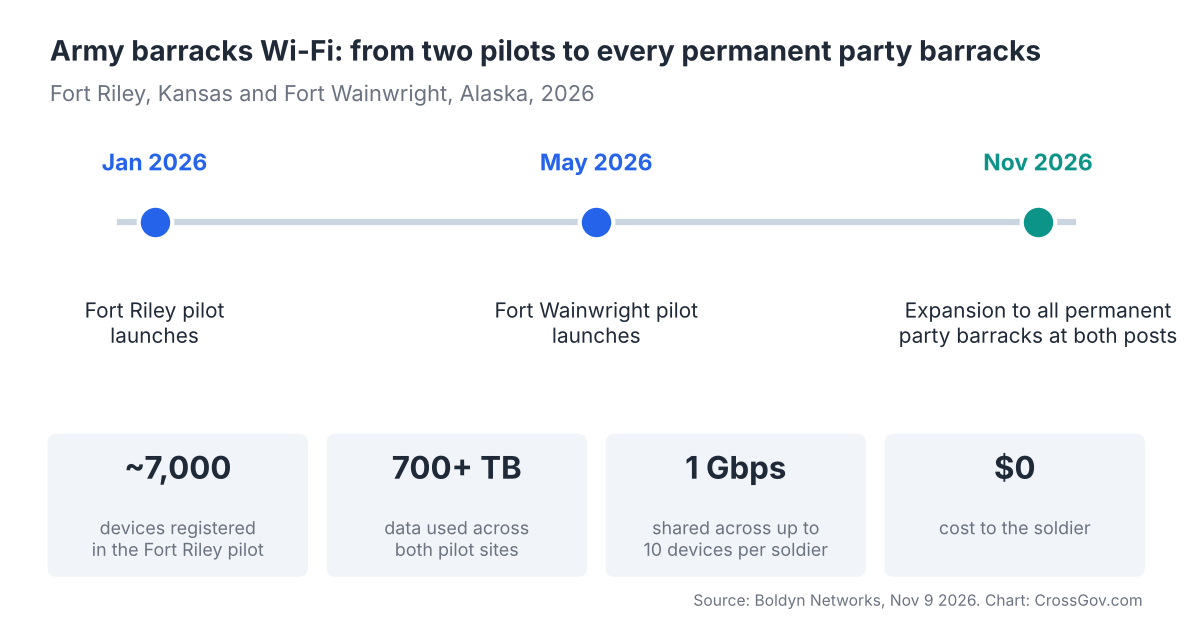
Chart: CrossGov.com from Boldyn Networks figures, hosted at Pxef.com
What soldiers get
Each soldier gets an individual account, up to 10 personal devices and speeds up to 1 Gbps shared across them, with round-the-clock US-based support. It costs the soldier nothing.
That last point is the change. Barracks internet has long been a sore point: soldiers living in unaccompanied housing often paid for their own connections, or used weak building networks, while families in on-post housing had more options. Fort Riley’s command sergeant major called connectivity “an obvious first step” to improving soldiers’ quality of life.
What the pilots showed
The Fort Riley pilot started in January 2026 and Fort Wainwright followed in May. At Fort Riley, unique accounts outnumbered the beds the service was sized for by a wide margin, and nearly 7,000 devices were registered. Across both sites, soldiers used more than 700 terabytes of data. In other words, demand was well above what the planners assumed.
How it was bought
The service is delivered through an Intergovernmental Support Agreement with the University of Alaska Fairbanks. IGSAs let a military installation contract with a state or local government, or a public university, for services the government partner can provide, often faster than through a standard federal procurement. The university is the Army’s partner, and Boldyn delivers the service under it.
The release gives no contract value and no funding source, and it doesn’t say how many rooms or soldiers the expansion covers. Those are the numbers that would show whether this is a cheap fix that scales or an expensive one.
What to watch
Two posts don’t make a programme. The questions are whether the Army extends the model to other installations, whether it keeps using IGSAs with universities to do it, and who pays once the pilots become a standing service. Free, fast barracks internet is a popular, visible quality-of-life benefit for young soldiers, and that tends to attract follow-on money. Watch for the next installation announcement and for any line in Army budget documents that names barracks connectivity.