An Unnamed US Customer Gives AeroVironment 315 Million Dollars Under a 940 Million Dollar IDIQ the Company Cannot Name
A US government customer has awarded AeroVironment a multiyear indefinite-delivery, indefinite-quantity contract with a $940 million ceiling, and placed an initial order of about $315 million. The company announced it on November 9. It did not name the agency or the program, because the customer’s operational security rules bar that, and it did not say what it will deliver beyond “established product lines” in its AxS segment.
That leaves a large federal purchase that the public can read only through its shape: a ceiling, a first order and a promise to build at scale.
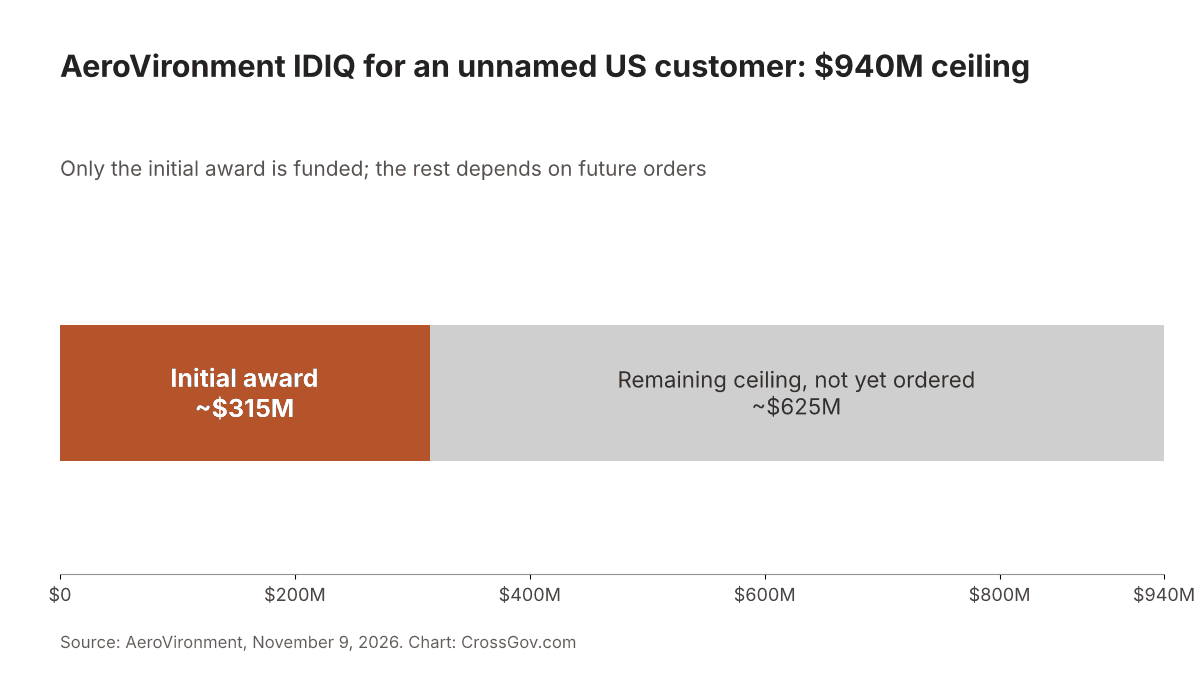
Chart: CrossGov.com from AeroVironment figures, hosted at Pxef.com
How an IDIQ actually spends money
An IDIQ is a framework, not a check. The government sets a maximum value and a period, then issues task or delivery orders against it as needs and appropriations allow. Only orders are obligated funds. The $940 million is the most this customer could spend through the vehicle. The $315 million is what it has committed so far, about a third of the ceiling.
AeroVironment’s own filing language makes the point. Its safe harbor statement warns that the ceiling may never turn into orders beyond the initial award, that future funding is uncertain, and that the government can modify or end the contract. Ceilings on defense IDIQs are routinely set well above what ends up being bought.
Why the customer stays anonymous
Pentagon contract awards of $7.5 million or more are normally posted in the daily Pentagon contract announcements, with the buying command named. Some are not. Classified programs, special operations buys and intelligence community purchases can be withheld, and companies are then cleared to announce only what the customer allows. That is what happened here.
The result is a gray zone. Congress can see the money through classified annexes and briefings. The public sees a press release with no buyer’s name.
The production push behind it
The award fits a policy the Pentagon has pushed since Pete Hegseth’s July 2025 memo on unleashing US military drone dominance, which told the services to treat small drones as consumables and buy them in volume. AeroVironment’s AxS president Trace Stevenson put the company’s answer plainly: “We are not preparing to manufacture at scale. We are doing it.”
For oversight, two questions follow. First, whether the remaining $625 million of ceiling gets funded in future appropriations. Second, how much of this kind of spending now runs through vehicles the public cannot trace to a program. A $940 million vehicle with no named owner shows how little of that picture reaches the public.