US Government News Digest for October 26 2026
Eight days before the midterms, Washington spent Monday arguing about who gets the last word. The Justice Department is in federal court in Alaska and California trying to shape how ballots are handled and results certified. A judge in Manhattan told the same department it had no right to fire a career prosecutor the way it did. Two senators say the administration is sitting on a surveillance court ruling the law says it should have published six weeks ago.
Two numbers ran underneath all of that. The Strategic Petroleum Reserve is at its lowest level since October 1982, and more than 50,000 radiation compensation claims are waiting for a decision. Neither is a headline grabber. Both say more about how the government is actually performing than most of what gets said at a podium.
This digest covers developments reported on Monday, October 26, with the California election case carried forward from a Sunday hearing. Several of these stories are still moving through the courts, so treat it as a snapshot of the day.
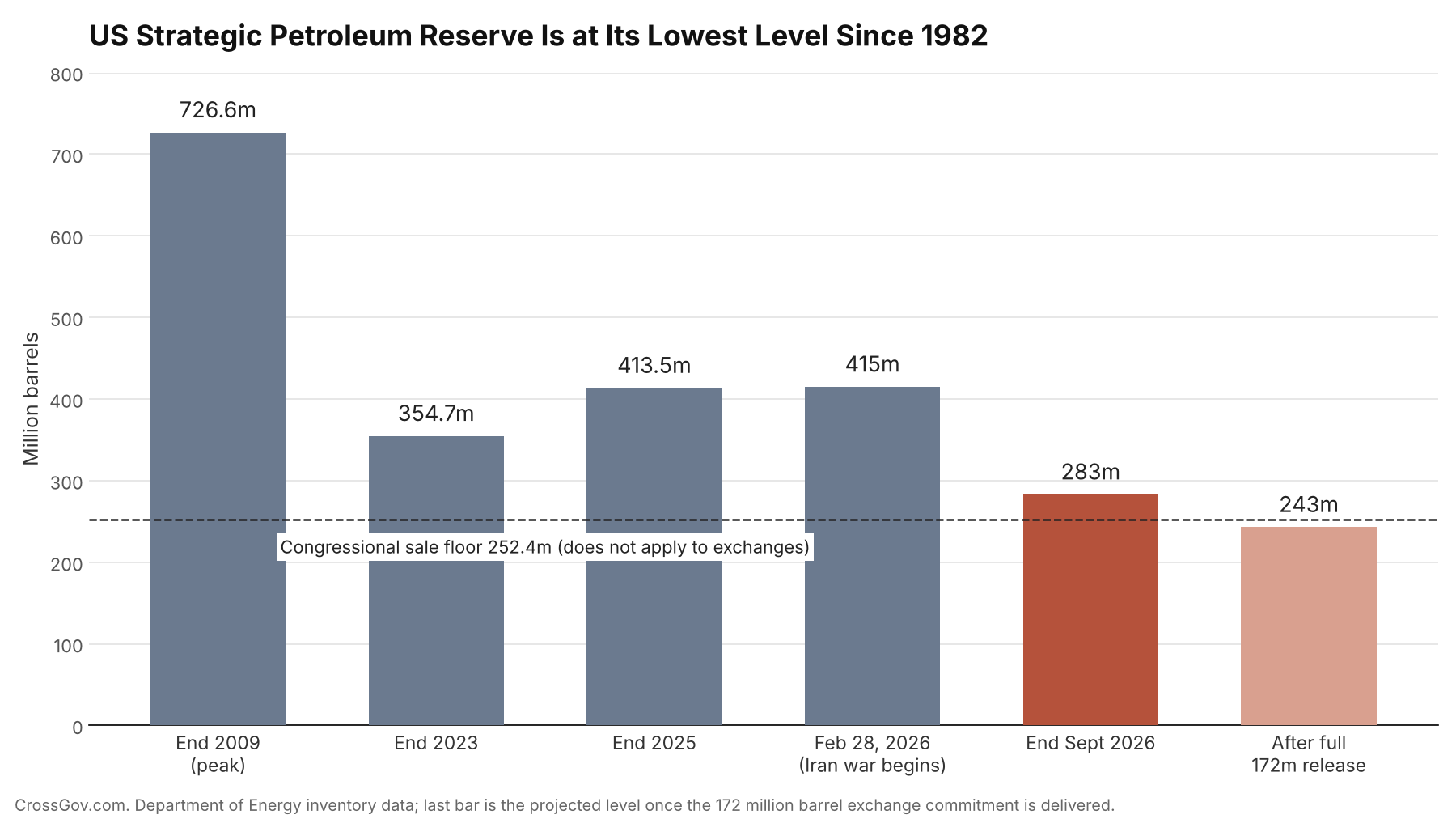
Chart: CrossGov.com, hosted at Pxef.com. Department of Energy inventory figures.
Alaska and the Two Dan Sullivans
The Alaska case is the stranger of the two election suits. On October 22 the Justice Department sued the state’s Division of Elections in federal court in Anchorage, asking that the Senate result not be certified if Republican incumbent Dan S. Sullivan loses to Democrat Mary Peltola. The case went to Judge Sharon Gleason.
The department’s theory rests on a second candidate. Dan J. Sullivan of Petersburg, registered as undeclared, is also on the ballot. The state tried to remove him in June, arguing his candidacy existed to confuse voters, but an Anchorage judge put him back and the Alaska Supreme Court upheld that on June 29. He took 2.5 per cent in the August primary. Washington now argues that his presence could mislead voters in a ranked choice count and that certification should wait for an investigation. The legal hook is the preamble of the National Voter Registration Act, which talks about protecting “the integrity of the electoral process.” Several election law scholars have called that thin, since a preamble does not usually create an enforceable claim.
Peltola has asked the court to dismiss the case and challenges the federal intervention outright. Attorney General Todd Blanche said over the weekend that the suit concerns possible legal violations, not a federal takeover of state elections. President Trump has said he ordered it. No ruling had been reported by Monday evening. Early voting in Alaska began on October 19, so whatever Judge Gleason decides will land on an election already under way.
The institutional question is plain. How far can Washington reach into a state’s certification process before the voters in that state have finished choosing a senator? We looked at the wider pattern in Federal Pressure on State Elections Is Testing the Boundaries of American Governance.
California Ballots and the 20,000 Name List
California is a separate test of the same authority. The Justice Department sued on October 15 to stop the state counting mail ballots sent to about 20,000 registrants it says are likely noncitizens. The list reached county officials on a password-protected thumb drive. Los Angeles County did not regard it as secure, and the secretary of state’s office said the password came on a sticky note.
The figure has a history. The Department of Homeland Security earlier put the number of noncitizens on California’s rolls at about 190,000. Attorney General Rob Bonta has pointed out how far it fell. Secretary of State Shirley Weber says Washington has produced no evidence for the 20,000 either, and she cited a Nevada case where flagged voters turned out to be citizens. Bonta says the state will not set ballots aside, and argues that federal law bars this kind of voter roll change within 90 days of an election.
At an unusual Sunday hearing, a Ninth Circuit panel of Judges Mark Bennett, Gabriel Sanchez and Patrick Bumatay questioned the department’s request for an order pending appeal. Two of them doubted the court should act before the district court rules on a temporary restraining order, with that hearing set for Tuesday. Judge Bennett pointed to the Elections Clause and to Smiley v. Holm, a 1932 ruling on state control of election mechanics. The department’s lawyer said he did not know the case. Judge Sanchez asked how the noncitizen list was compiled and which outside data sources fed it. The department could not say. Judge Bumatay raised the Purcell principle, which warns courts off late changes to election rules, though he showed some sympathy for the department’s argument about irreparable harm.
The panel promised a quick decision. Scepticism at argument is not a judgment, and appearing on a federal list is not proof that someone is ineligible to vote. For county registrars the practical worry is simpler. Will a court order arrive in the middle of tabulation and change how ballots are handled?
Maurene Comey Wins Her Case Against the Justice Department
In Manhattan, Judge Jesse Furman ruled on Monday that the Justice Department broke federal civil service law when it fired Maurene Comey, a career prosecutor in the Southern District of New York, on July 16, 2025. Pam Bondi was attorney general at the time.
The department argued that prosecutors exercise executive power, so the president or the attorney general can remove them at will. Judge Furman rejected that. Congress gave career prosecutors removal protections, and the court held those protections mean something.
The remedy is narrower than the headline. Comey is to be reinstated retroactively from July 16 through December 20, 2025, with back pay and the matching retirement credit. She is not going back to her old desk, because she has since joined a New York law firm. Her suit had also alleged she was targeted because of her father, former FBI Director James Comey, and her perceived politics. A remaining claim still needs to be resolved, and the department has not said publicly whether it will appeal.
Comey spent nearly a decade as an assistant US attorney and worked on the prosecutions of Ghislaine Maxwell and Sean Combs. Strip away the surname and the case is about every career lawyer in the department. Do the employment protections Congress wrote still hold when political leadership wants someone gone? For now one federal judge says yes. That question sits beside the wider fight over removal power we covered in After Trump v. Slaughter.
The Surveillance Court Opinion Nobody Has Seen
Senators Ron Wyden and Adam Schiff, joined by civil liberties groups, pressed the administration on Monday to explain why a Foreign Intelligence Surveillance Court opinion dated March 17 is still classified. They say the statutory deadline for releasing it passed on September 13, and that Blanche had personally committed to meeting it. Wyden says the opinion shows major compliance problems in surveillance under Section 702. They want answers by November 6.
This is the second missed date. In May, Senate Intelligence Committee leaders Tom Cotton and Mark Warner asked for the opinion to be released by May 15, so the Senate would have it in hand for the Section 702 debate. That did not happen either.
Section 702 itself lapsed in June, the first time since 2008. Collection has not stopped. It continues under existing court approvals that run into March 2027, which means the hard deadline for Congress is spring, not today. The civil liberties groups want lawmakers to refuse any renewal while the opinion stays hidden, and to add a warrant requirement before agencies can search Americans’ communications. The unresolved issue is whether Congress debates renewal with a public account of what the court found. The claim that the opinion is being withheld unlawfully is the senators’ position. The administration has not answered it.
The Petroleum Reserve Runs Low
Figures reported Monday put the Strategic Petroleum Reserve at 282.6 million barrels. That is the lowest since October 1982 and well under half the 726.6 million barrels held at the end of 2009. On February 28, when the Iran conflict began, the reserve held about 415 million barrels.
Most of the drop comes from a March commitment to move 172 million barrels as the US share of a 400 million barrel release coordinated through the International Energy Agency. These are exchanges, not sales. Companies borrow the oil and return it later with a premium of 18 to 28 per cent, some of it not due until late 2028. A final 40 million barrel tranche was offered on September 29 for delivery in November and December. Once all of it goes out, the reserve could bottom out near 243 million barrels. That is below the 252.4 million barrel floor Congress set for sales, but the floor does not apply to exchanges. On October 2 the G7 agreed to release another 100 million barrels of crude and diesel over four months.
Separately, the Department of Energy last week authorised an emergency exchange of up to 400,000 barrels for Phillips 66’s Lake Charles refinery in Louisiana, which processes about 264,000 barrels a day, after disruptions to its crude deliveries. That is the reserve doing its routine job of covering a local supply gap. It should be judged separately from the strategic drawdown.
Refilling is the hard part. The Department of Energy puts the cost of buying back about 250 million barrels at roughly $20 billion near $80 a barrel. Congress has set aside $171 million, about enough for 2 million barrels. GAO found the sites fill far below their design rate, so even with the money a full refill would take years. The reserve can cushion this emergency. Every barrel used now is a barrel unavailable for the next one.
Radiation Compensation Claims Pile Up
The Justice Department published updated Radiation Exposure Compensation Act figures on Monday. Under Public Law 119-21, the July 2025 budget law that revived and widened the programme, 50,264 claims are pending against 12,645 approvals and 199 denials. Approved compensation totals $883,414,184.
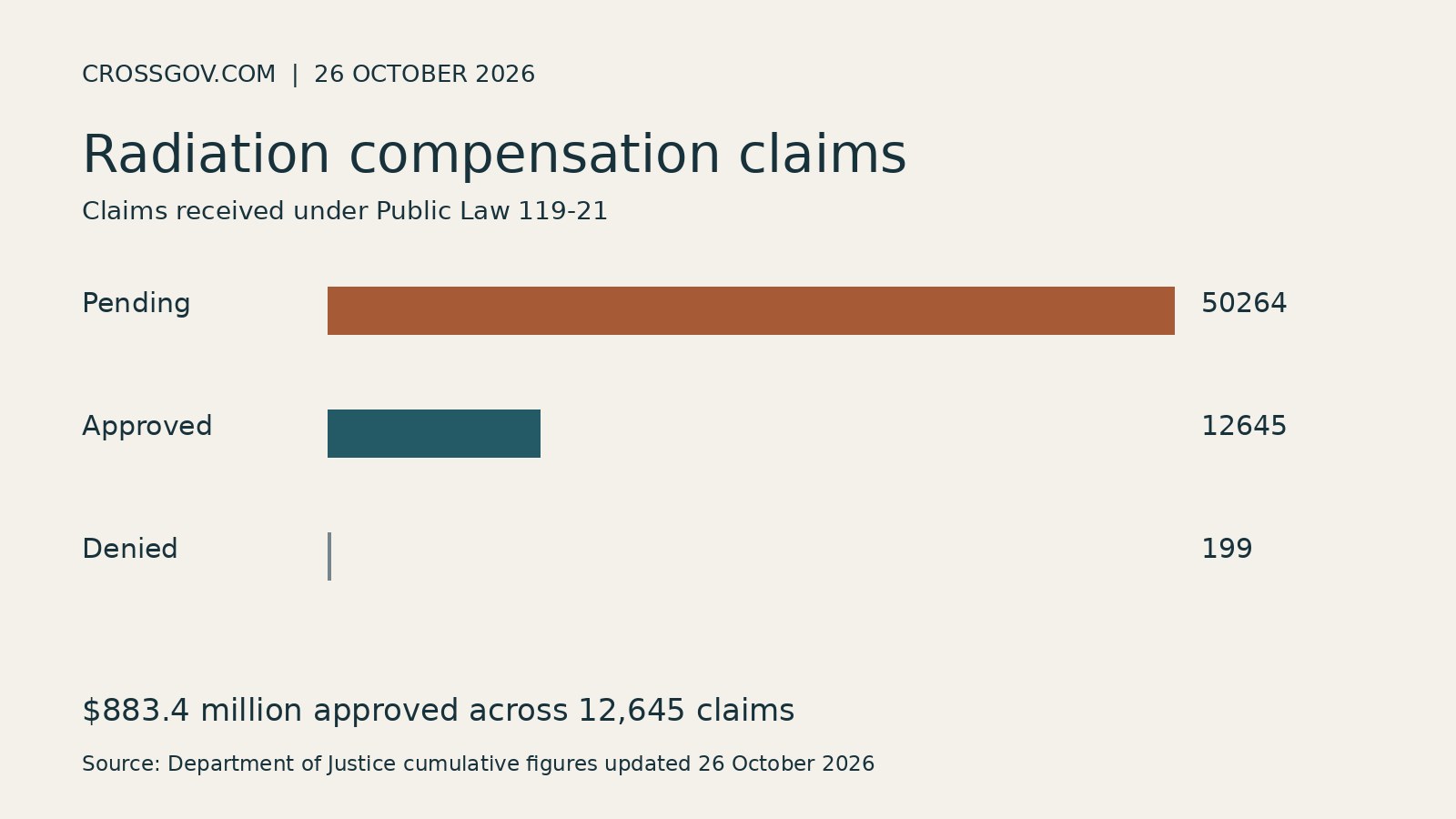
Chart: CrossGov.com, hosted at Pxef.com. Department of Justice cumulative figures updated October 26, 2026.
The 98.5 per cent approval rate applies only to claims already decided. It does not mean nearly every applicant has had an answer. The pending pile is almost four times the number approved, so processing capacity matters as much as eligibility. These are cumulative totals, not one day’s activity.
The backlog follows from the law’s reach. It extended downwinder coverage to all of Idaho, Utah and New Mexico and to lower Mohave County in Arizona, raised downwinder and onsite participant awards to $100,000, added uranium workers employed from 1971 to 1990, and created a new track for people exposed to Manhattan Project waste in parts of Missouri, Alaska, Kentucky and Tennessee. Claims can be filed until December 31, 2027. The department’s own budget documents estimated up to 100,000 new claims over the filing window. The Congressional Budget Office expected about 75,000. Half the window is not yet gone and the pending count has already passed 50,000.
What to Watch
The common thread is the practical reach of federal authority. Who controls ballot handling and certification? What limits protect career officials? What must intelligence agencies disclose to the public? How do agencies manage resources that do not refill on their own?
The next real signals are written rulings in Alaska and California, the district court hearing in California on Tuesday, any appeal in the Comey case, the administration’s response to the senators by November 6 and the next Energy and Justice department data releases. Election Day is November 3. Until rulings are written, claims and arguments should be kept apart from decisions.
Washington produces plenty of all three.