FCC Votes to Bar Chinese Test Labs That Check 82 Percent of US Electronics by December 2028
The Federal Communications Commission voted on October 29 to stop recognizing test labs and certification bodies in countries that don’t give American labs the same treatment. China is the one that matters. From December 2028, a phone, laptop, router or camera that needs FCC approval before it can be sold in the United States can no longer be tested in a lab in mainland China.
That covers most of them. FCC Chairman Brendan Carr says labs in China tested 82 percent of the devices that applied for FCC authorization in 2025. Labs inside the United States tested about 4 percent. The draft order counts 609 recognized labs worldwide, a quarter of them in China, and notes that in 2007 the split ran the other way: US labs handled about 31 percent of applications, Chinese labs about 13 percent.
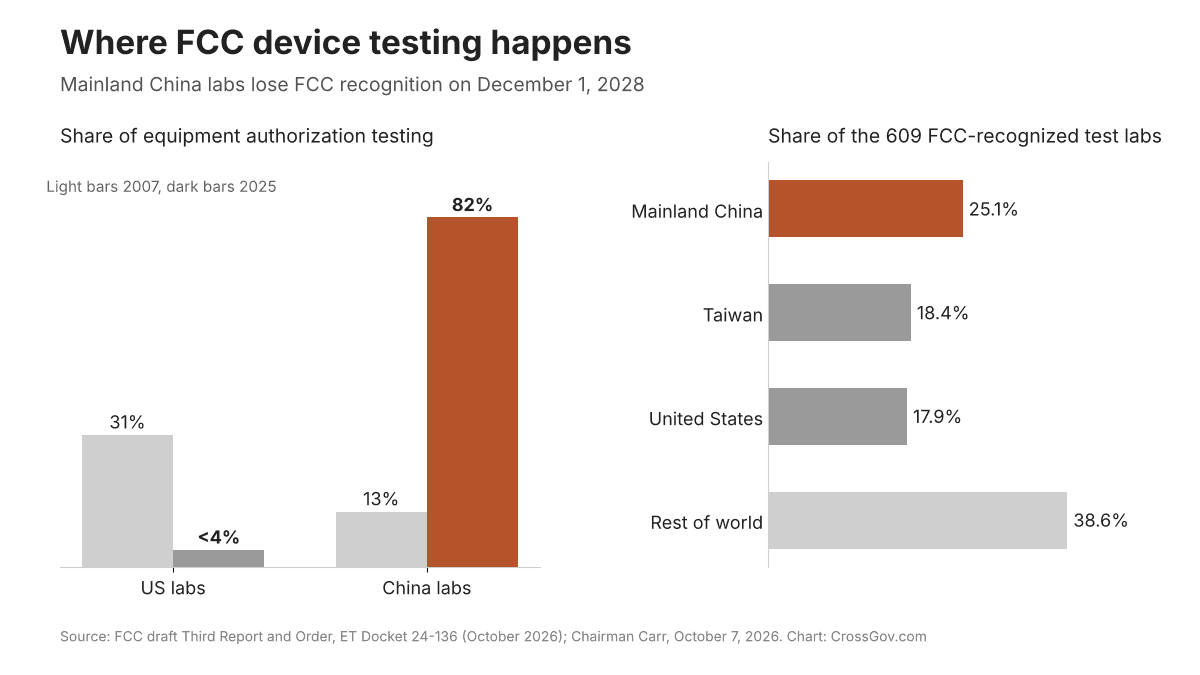
Chart: CrossGov.com from FCC figures, hosted at Pxef.com
How the cutoff works
The item is a Third Report and Order in ET Docket 24-136, with a further notice attached. It ties recognition to reciprocity. Test labs, certification bodies and lab accreditation bodies keep FCC recognition only if they sit in the United States or in an economy with a mutual recognition agreement or a reciprocal trade arrangement with Washington. The FCC had a reciprocity requirement until 2015, then dropped it. This puts it back.
The adopted text hasn’t been released yet. In the draft circulated on October 8, the list of reciprocal economies runs past 60 names, Japan, Taiwan and Vietnam among them. Hong Kong is on it too, though the April proposal had swept Hong Kong labs in with the mainland. Hong Kong keeps its place through an APEC telecom recognition arrangement, even though Beijing has run the city under its National Security Law since 2020.
Nothing already approved is undone. Existing equipment grants stay valid, devices on the market don’t need retesting, and applications filed before December 1, 2028 go through under the current rules. Labs in China keep working until then, and any new recognition the agency grants them in the meantime expires on that same day. The draft offers no waiver for individual labs. It also turned down a wider ban, backed by the Foundation for Defense of Democracies, on labs anywhere in the world owned by companies from non-reciprocal countries.
From bad labs to all labs
This is the third step in about 18 months. In May 2025 the commission barred labs owned or controlled by foreign adversary governments, a rule that has since cost 29 labs their recognition by the draft’s count. On April 30, 2026 it set up a fast track for devices tested in US labs and labs in trusted countries, and proposed the country-wide cutoff it adopted today. In between, the agency found 33 incorrect or false test reports from one Chinese lab, SLG-CPC Test Laboratory, some of them identical reports filed for different products. That lab has lost its recognition.
The lab rule reaches further than the Covered List bans, which go after named companies and product types: new foreign-made drones since December 2025, new foreign-made consumer routers since March 2026, and since October 13 any device with logic-bearing parts from Covered List firms, covered in our earlier post. Testing is the gate every radio device passes through. So the new rule touches every Chinese-made charger, smart plug and accessory that clears those lists, and every American or European brand that ships its hardware to Shenzhen for testing. Western testing firms are caught as well. SGS, Intertek, TÜV Rheinland and Bureau Veritas all run labs in mainland China, and those lose recognition on the same date as Chinese-owned ones.
Who pays and where the work goes
Testing moved to China for two reasons. The labs sit next to the factories, and they’re cheap. Compliance data firm MarkReady put basic FCC certification testing at $400 to $1,300 in China against $3,000 to $4,000 in the United States. The bill lands on manufacturers first and buyers later, hardest on low-cost devices where a few thousand dollars of testing per model is a real share of the margin.
Industry pushed back. The Consumer Technology Association, the Information Technology Industry Council and the Alliance for Automotive Innovation opposed the rule, and several commenters asked for three to five years to adjust. The commission gave about two and said the claims of reliance on Chinese labs mostly lacked evidence. China’s WTO enquiry point for technical barriers to trade filed against the rule as discriminatory. In April, Beijing’s foreign ministry accused Washington of overstretching the idea of national security.
The capacity question is open. US labs hold about 18 percent of FCC recognitions and win under 4 percent of the work, so the labs exist and the prices don’t compete. Taiwan already has more recognized labs than the United States, and Hong Kong, Vietnam and Japan stay eligible. A lab in Taipei or Hong Kong is a short flight from Shenzhen. The further notice adopted with the order asks how to bring testing back to American soil.
Twenty-five months is the clock.