US Jury Convicts Huawei of Bank Fraud and Trade Secret Conspiracy, Acquits It of Racketeering Conspiracy
A federal jury in Brooklyn convicted Huawei Technologies on November 24 of bank fraud and conspiring to steal trade secrets. It also acquitted the Chinese telecommunications company of the most serious charge it faced, conspiracy to commit racketeering, the Associated Press reported. The split verdict closes a 12-week trial before US District Judge Ann M. Donnelly. It leaves a fairly precise boundary around what prosecutors proved. They secured convictions over how Huawei obtained American technology and what it told banks about its business in Iran. They failed to persuade the jury beyond a reasonable doubt of the broader racketeering agreement they alleged.
One way into the bank fraud case is to follow the pay of engineers working in Iran. A British staffing company supplied the engineers for work that Skycom, a company Huawei controlled, carried out for Iranian telecom operators. Skycom paid the staffing company in Britain from bank accounts in Asia. Neither end of those transfers was in the United States, yet the payments went through the American banking system because the parties settled them in US dollars. The statement of facts that Huawei chief financial officer Meng Wanzhou signed in 2021 traces roughly 80 such payments totaling at least $7.5 million. That figure covers the staffing payments alone.
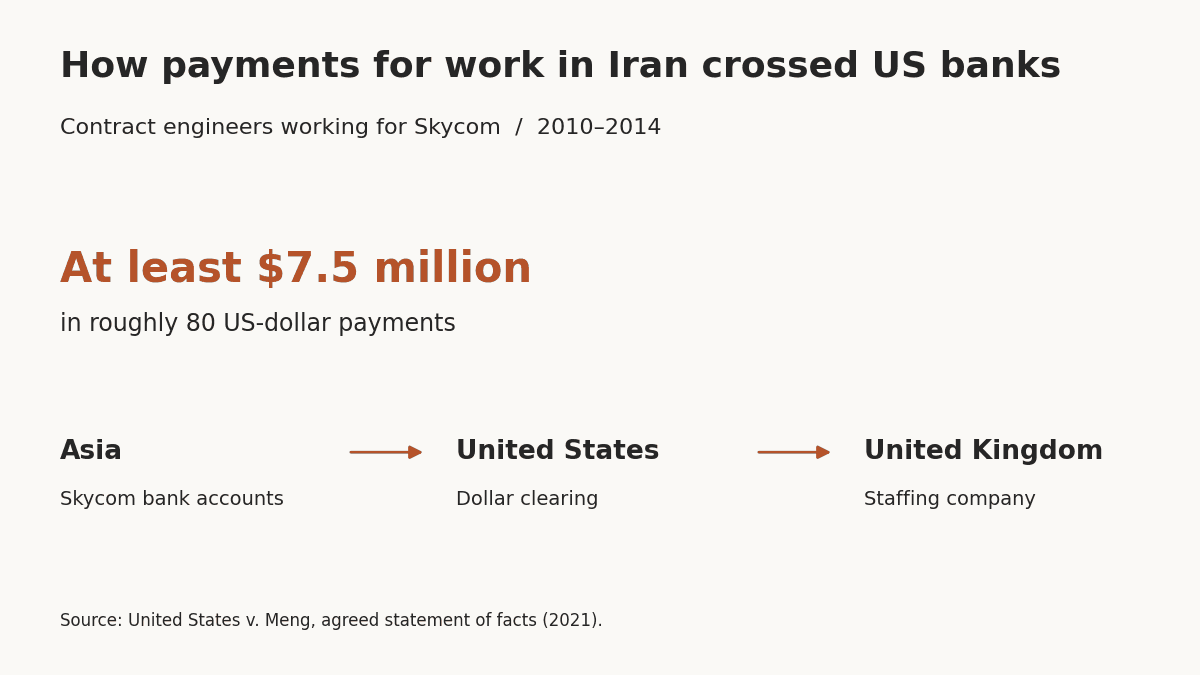
Chart by CrossGov.com using figures from the agreed statement of facts, hosted at Pxef.com.
In August 2013, a bank executive met Meng in Hong Kong to ask about the relationship. Meng described Skycom as a business partner and said Huawei had sold its shares. The buyer, however, was another entity Huawei controlled. Huawei made Skycom’s major business decisions, and a Huawei employee ran its Iranian operation. The distinction mattered to the banker across the table. A bank deciding whether it could keep clearing dollars for Huawei needed to know whose business it was financing. The staffing payments show what that question meant in practice. A bank handling a transfer to a British company could be providing a prohibited financial service for work in Iran.
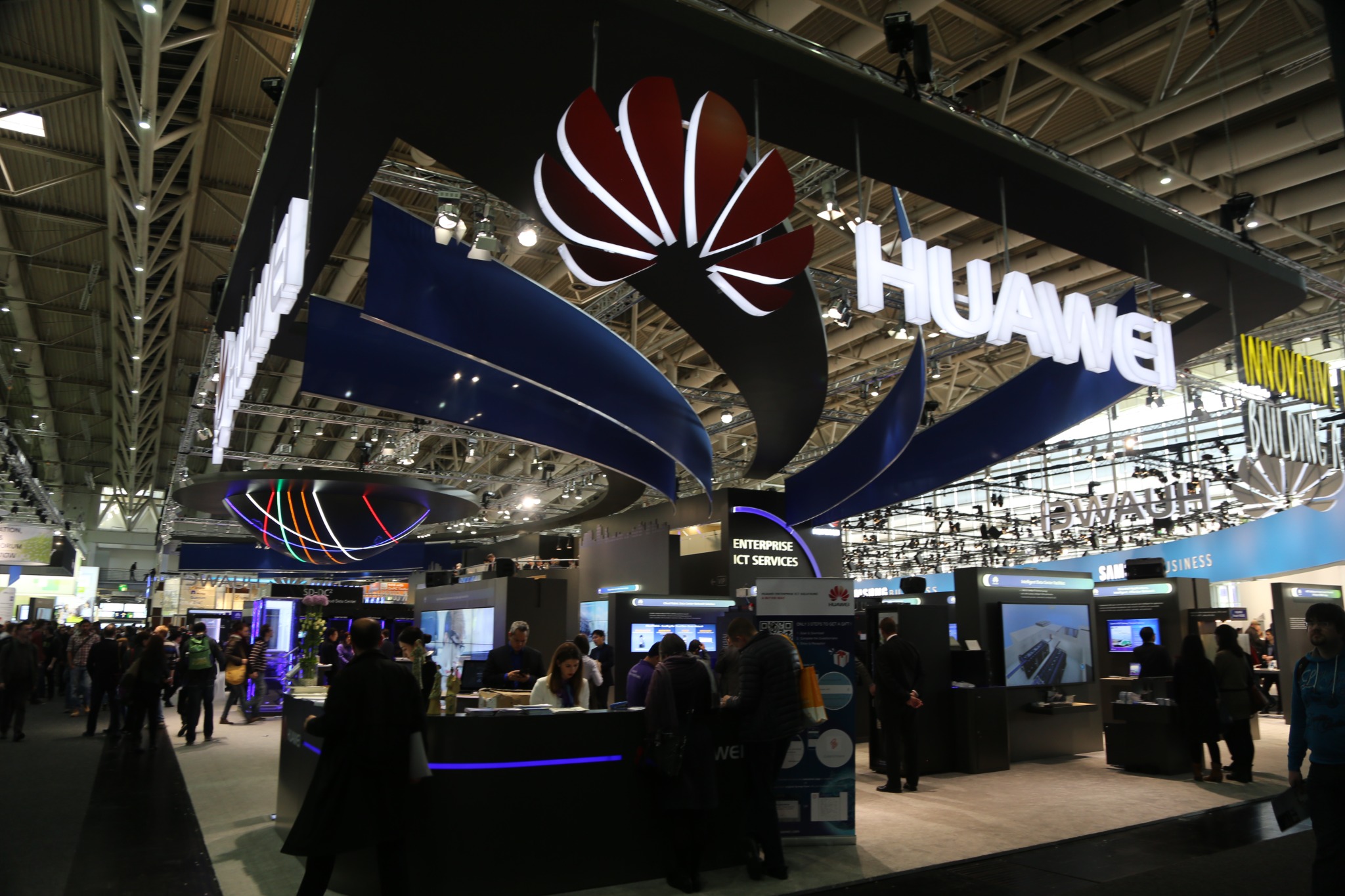
At Huawei’s exhibition booth, curved blue panels sweep out beneath the red emblem and illuminated white lettering. Visitors stand at demonstration screens under a sign for enterprise ICT services. The trade secrets case reached into an earlier stage of that business, when engineers were still sharing designs behind closed doors. Photograph hosted at Pxef.com.
The trade secrets evidence involved a different kind of access. Quintel, an American antenna manufacturer, shared an idea with Huawei under a confidentiality agreement. According to the US Attorney’s account of the trial evidence, Huawei then submitted a patent application incorporating the idea and attached a confidential slide Quintel had supplied. The slide gave prosecutors something concrete to put before the jury. They could trace material from a private exchange between companies into an application Huawei filed in its own name.
The racketeering count asked the jury to go further. In its 2020 superseding indictment, the government put the pursuit of technology and markets inside a single account of how Huawei and its affiliates operated. Under the federal racketeering statute, prosecutors alleged an agreement to conduct the enterprise’s affairs through a pattern of criminal activity. A juror could find an agreement to steal trade secrets and still have reasonable doubt about that larger agreement. The acquittal leaves the jury’s reasoning private. It also limits what Washington can claim about the case after years of describing the company’s conduct in sweeping terms.
Sentencing will determine the financial consequences. Huawei and three subsidiaries received guilty verdicts, with the counts varying by defendant. The Justice Department says the companies face possible fines, forfeiture and restitution. The $7.5 million in the court filing measures payments to a contractor years before the trial. The amount Huawei and its subsidiaries will owe as a result of these convictions remains for the court to decide.